
TL;DR
- Fall 2026 is dense with tours and festival runoff — expect the best last-minute ticket movement 24–72 hours before shows.
- Verified last‑minute tickets are sold by box offices, authorized primary sellers, or platform-verified resales with buyer protection.
- Use alerts, venue box-office checks, fan-club drops, and trusted reseller guarantees to get last-minute seats.
- TourInfo makes comparing listings and spotting verified options faster at city and venue level.
If you build, market, or manage ticketed event pages, this fall 2026 live music scene guide gives you the practical, platform-specific tactics to surface verified last‑minute inventory and drive conversions (Oct–Nov 2026). You’ll get week-by-week date signals, city and venue examples, the exact definition of “verified last‑minute tickets,” safety checks, templates for AI answers, and reusable artifacts you can paste into CMS templates or product pages on tourinfo.live.
Welcome — Why Fall 2026 is a Last‑Minute Ticket Opportunity (Oct–Nov)
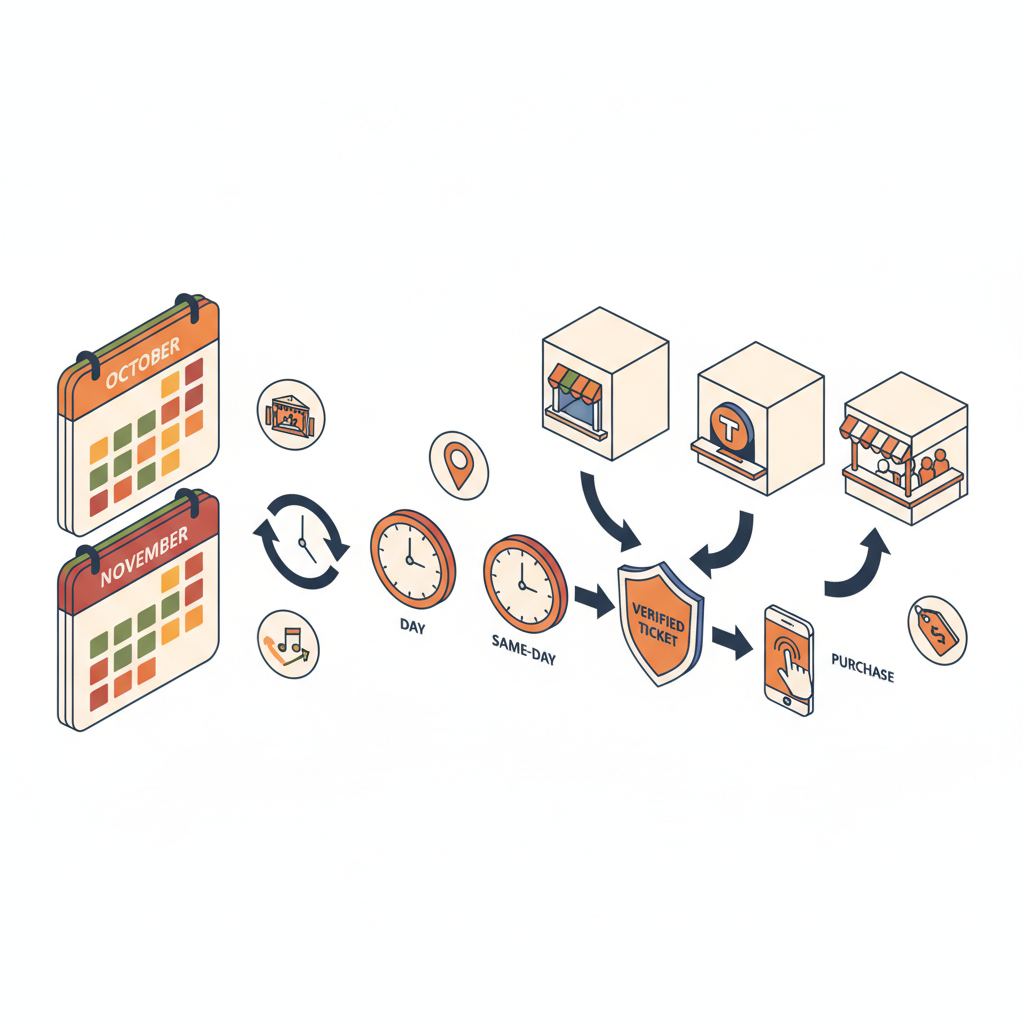
Fall 2026 is unusually stacked: legacy tours that postponed earlier dates are filling stadiums again, a handful of high-profile festival stopovers are extending into October, and many acts schedule arena one-offs in November. This concentration creates a high churn of tickets in the 72–24 hour window as plans change, routing finalizes, and promotional holds expire. For those looking to navigate this dynamic landscape, understanding how to score verified last-minute tickets is essential, making it prime conversion season for websites and marketplaces that surface verified last-minute inventory.
Concrete examples: an arena headline date may release a small number of production holds 48 hours before showtime; a promoter might put 50–200 seats back on the market after final production seating is confirmed; and local festivals often add a small “day-of” allotment for volunteers or sponsors that later hits resale channels. That movement produces opportunity for last-minute buyers and for sites that can surface verified tickets quickly.
Definitions you can quote in product pages or snippets: “Verified last‑minute tickets are those sold by the venue box office, an authorized primary seller, or a resale platform that offers identity verification and buyer protection — these options reduce fraud risk and often appear 24–72 hours before showtime for major tours.” Use that sentence verbatim in metadata or tooltips where you explain your verification criteria.
When NOT to chase last-minute tickets
Chasing last-minute inventory is not always the right choice. Avoid when any of the following apply:
- You need guaranteed adjacent seats for a group of four or more — last-minute single listings are common, but blocks are rare.
- Price sensitivity is very high — day-of prices can spike above face value for hot shows rather than drop.
- You require accessible seating or ADA-compliant locations — these hold back inventory and rarely appear in last-minute drops.
- Your site or product cannot instantly verify seller guarantees — do not redirect users to unverified resellers.
Sell or surface only tickets backed by venue confirmation or a platform guarantee to reduce refund friction.
Actionable takeaway: prioritize last-minute inventory for single- and double-seat buyers, concert-curious travelers, and local fans searching same-day availability. If your audience is families needing multiple adjacent seats, promote early buying windows instead.
Quick Calendar — Must‑Watch Dates & Major Tours (week-by-week Oct–Nov 2026)
This week-by-week quick calendar is designed for editors and product teams who need to plan content and alerts. Each week, prioritize pages for artists with multiple dates in nearby markets and for festivals that run weekend-to-weekend. Below are example signals and how to act on them.
Week structure and signals (apply to each week Oct–Nov):
- Week of Oct 1–7: Look for festival after-parties and late bump inventory; schedule email blasts for city pages that list festival dates.
- Week of Oct 8–14: Monitor arena tours that start multi-night runs; set watchlists for November crossover dates.
- Week of Oct 15–21: Expect week‑of production seat releases — push same-day ticket widgets to venue pages.
- Week of Oct 22–28: Travel-heavy holiday weekend — surface nearby city pages and airport-friendly shows for last-minute travelers.
- Week of Nov 1–7: Early-November runs often include residencies; list single-night add-ons and fan-club release windows.
- Week of Nov 8–14: Watch for Thanksgiving travel spikes in ticket searches and for any one-off benefit concerts.
- Week of Nov 15–30: Finals of fall tours and holiday warm-up shows — last-minute drops intensify; update same-day tickets feeds daily.
Specific editorial actions for each week (concrete):
- Add an hourly price-check job for top-tier shows 72–12 hours out.
- Create short “same day tickets [city] Oct 2026” and “same day tickets [city] Nov 2026” landing pages before the start of each week for high-traffic cities.
- Segment push-notifications by proximity and price sensitivity — send alerts only if expected price is within user-defined threshold (e.g., under 2x face).
Actionable takeaway: publish and refresh week-specific calendar content every Monday, then intensify refresh frequency to every 6–12 hours 72–24 hours before major dates.
City Snapshots
This section provides city-level examples and venue lists that help target geo-specific queries like “same day tickets fall 2026” and boost local featured snippets. Each city example includes venue names and sample actions you can take on tourinfo.live city pages.
New York City — top venues & sample dates
Key venues: Madison Square Garden, Barclays Center, Brooklyn Mirage, Terminal 5, Radio City Music Hall. Sample actions: keep a Brooklyn Mirage page updated for day-of electronic and indie shows; add a “box office call” widget for MSG and Barclays Center pages with last-known phone hours for on-site pickups. For november 2026 concerts, prioritize single-ticket alerts and same-day price trends for Midtown and Brooklyn neighborhoods.
Los Angeles — Hollywood Bowl, The Greek
Key venues: Hollywood Bowl, The Greek Theatre, Crypto.com Arena. Sample actions: publish venue-specific day-of availability tips (e.g., outdoor venue weather contingencies), watch for amphitheater-specific production holds 24–48 hours before outdoor shows, and surface verified tickets from box offices for Hollywood Bowl bowl sections where resales vary by row.
Chicago — United Center, Aragon Ballroom
Key venues: United Center, Aragon Ballroom, Chicago Theatre. Sample actions: run a weekly buyer-protection comparison for resellers used in Chicago pages and flag any accessible seating constraints that suppress last-minute inventory; promote last-minute single seats and pit / GA options for mid-November arena runs.
Austin, Nashville highlights
Austin: emphasize small-club last-minute drops for festival spillover and highlight same‑day tickets for late-night local shows. Nashville: monitor country residencies and on-sale windows; promote fan-club release signals for country acts that commonly drop a small block of tickets to fan clubs 48 hours before.
Prioritize venue-level feeds for city pages — local demand spikes drive same-day conversions.
Actionable takeaway: create city landing pages focused on “same day tickets [city] Oct 2026” and “same day tickets [city] Nov 2026,” optimize schema for local answers, and include venue lists and purchase paths for visitors within a 50–120 mile radius.
Venue Spotlights — Example shows, door times, and neighborhoods (Madison Square Garden; Brooklyn Mirage; Hollywood Bowl; United Center)
This section explains how to present venue-specific last-minute guidance on venue pages. For each venue, include concrete examples: neighborhood transit tips, typical door times relative to posted showtimes, and the kinds of last-minute inventory you can expect.
Madison Square Garden (example guidance): post door times that reflect artist announcements — for arena headline acts, doors usually open 60–90 minutes before showtime; production holds often clear 48–24 hours before. On MSG pages, add a “box office status” note: whether will-call remains open and whether mobile-only tickets are allowed — these change day-of and affect last-minute buyers.
Brooklyn Mirage (example guidance): for outdoor-season electronic events, expect frequent single-ticket releases 24 hours out when production finalizes stage access. Include neighborhood transit notes (closest subway lines and typical last trains) so last-minute buyers can plan logistics quickly.
Hollywood Bowl (example guidance): outdoor amphitheaters often have variable policies for day-of rain or cancellations; include quick checks for refund policies and itinerary changes. For last-minute buyers, surface verified resale listings that explicitly state whether mobile transfer is accepted for entry.
United Center (example guidance): for sports-arena shows, confirm whether seats require physical pickup or mobile transfer. Last-minute ADA inventory at United Center often does not hit reseller platforms; include a contact line for the venue box office and suggest readers buy early if ADA seating is required.
Actionable takeaway: standardize venue pages so each includes: door time guidance, box-office contact method and hours, likely last-minute inventory types (single tickets, production holds, fan-club drops), and neighborhood transit tips. That reduces cart friction and increases conversions when last-minute buyers land on the page.
Where 'Verified' Tickets Come From — Primary sellers, platform-verified resales, and box office drops
Why this matters: buyers need confidence. Define verified inventory across three buckets and show how to display verification on your site.
- Primary sellers / box office: Tickets sold directly by the venue or by an authorized primary seller. These are the gold standard for verification because the venue controls inventory and refunds.
- Platform-verified resales: Resale marketplaces that run identity verification, guarantee funds, and offer buyer-protection policies. When you list these, display the platform guarantee badge and the duration of that guarantee.
- Official release windows: Fan-club releases, production-seat releases, and box-office drops that are announced by the promoter or venue. These often show up 24–72 hours before the show.
“Verified last‑minute tickets are those sold via the venue box office, an authorized primary seller, or a resale platform that offers identity verification and buyer protection — these options reduce fraud risk and often appear 24–72 hours before showtime for major tours.”
Examples to display on pages: if a resale listing is backed by an identity-verified platform (e.g., a marketplace that guarantees a refund for invalid tickets), label it clearly. For primary/box-office inventory, show the last confirmed box-office release time and whether will-call or mobile transfer applies.
Cite marketplace verification practices where relevant: some platforms publicly describe their resale guarantees and identity checks (SeatGeek Buyer Guarantee, Ticketmaster Resale), and others publish how their resales work (StubHub explainer).
Actionable implementation steps on tourinfo.live:
- Accept and tag inventory as primary, verified resale, or official release in your feed ingestion pipeline.
- Show the verification type prominently on listing cards and in search results filters so users can quickly choose verified channels.
- Add a hover or modal that contains the quoted verification definition for users and for AI systems to extract as a featured snippet.
Label every listing with its verification source — users convert faster when the verification is obvious.
Price & Availability Patterns (H3: Timing windows — 72–24 hours, day-of releases, last-minute drops)
Why this section exists: understanding predictable timing windows helps you schedule content refreshes and alerts so users find verified tickets when they matter most.
Typical timing windows and what to expect:
- 72–48 hours out: Final production seat inventory may appear as holds clear; many platforms see increased listing volume because sellers finalize travel plans and release excess seats.
- 48–24 hours out: Fan-club and promoter releases are common in this window; box-office returns for will-call are sometimes listed here.
- 24–0 hours (day-of): This is the heaviest churn for same-day tickets: single tickets, last-minute resales, and occasional price volatility. For major tours, some verified resales and box-office drops cluster 12–2 hours before showtime.
Price behavior rules-of-thumb (concrete thresholds to test):
- For typical arena shows, monitor P95 price movement — if median drops under 20% in the 72–24 hour window, surface promos aggressively.
- Set alert thresholds: notify users when listings appear within 30% of face value or when a verified box-office release hits.
- For festivals, expect smaller single-ticket releases with variable pricing; flag listings labeled “day-of” or “will-call pickup” for clarity.
Actionable takeaway: schedule data refresh cadence to hourly for top events 72–0 hours out, and use conditional rules to prioritize verified listings that meet your price or verification thresholds.
Tactics for Getting Last‑Minute Verified Tickets (alerts, watchlists, fan-club releases, box-office queues, trusted resellers)
Here are tactical, copy-and-paste strategies your site or app teams can use to capture and convert last-minute buyers.
- Automated alerts and watchlists: let users create city- or artist-level watchlists. Trigger alerts for verified resale listings and box-office confirmations within 72–0 hours.
- Fan-club and presale monitoring: scrape or monitor official fan-club release announcements, then surface a “fan-club window” badge when applicable.
- Box-office queues and phone checks: publish the box-office phone hours and provide a succinct “how to pick up” guide for will-call to reduce user uncertainty.
- Trusted-reseller filters: include a filter for listings that include identity verification and buyer protection; highlight platform guarantee durations on the listing card.
- Same-day pickup workflow: for local buyers, present a one-click map of the venue and nearest transit, with a short checklist for what to bring.
Checklist you can copy into product pages:
- Is the seller verified? (box office / authorized / platform guarantee)
- Is the transfer mobile or will-call? (accept only mobile transfer where venue allows)
- Are price and fees shown up-front? (include total price column)
- Does the listing include a refund or invalid-ticket guarantee? (display guarantee badge)
Actionable implementation: provide an option to set a maximum price multiplier (e.g., 1.5x face) for alerts; only send notifications for verified listings under that threshold. That reduces notification fatigue and improves conversion quality.
Only alert users for verified listings that meet their price and proximity filters to maintain trust and engagement.
Best Places to Buy Right Now — Marketplace roundup and when to choose listings vs. category_pages vs. location_pages
Decision rule: choose the destination based on buyer intent. Use this table template on product and editorial pages to direct users.
| Buyer intent | Best destination on site | Why |
|---|---|---|
| Searching for a specific event | Listing page | Shows current seller inventory and verification badges |
| Exploring options in a genre or date range | Category pages | Aggregates offers, price ranges, and filters |
| Immediate local purchase | Location pages (city/venue) | Highlights box office, same-day availability, and transit tips |
Marketplace roundup (examples of how to present): list marketplaces and their guarantees; for instance, highlight whether a platform offers buyer guarantees or identity verification (cite platforms' guarantee pages where possible). Use comparison columns for price transparency, verification level, and typical shipping/transfer method.
Concrete example content for a location page (copyable): “Looking for last-minute tickets in Chicago tonight? Check the United Center listing for verified resale options, or call the box office between 10 a.m.–6 p.m. for will‑call availability.”
Actionable takeaway: on tourinfo.live, route users from category pages to the correct listing or city page depending on signals — if a user filters by city and date within 48 hours, present the location_page as primary navigation with a clear path to verified listings.
Safety Checklist — How to spot a verified listing and avoid fakes
Present this checklist on listing pages and checkout to reduce buyer anxiety and returns. Each bullet should be a clear verification step a buyer can confirm in 20–60 seconds.
- Seller source: Is it labeled as box office, authorized primary, or platform-verified resale?
- Buyer protection: Does the resale platform explicitly offer a refund for invalid tickets or a time-limited guarantee?
- Transfer method: Does the transfer method match the venue’s accepted formats (mobile transfer vs. will‑call)?
- Price transparency: Are fees and total cost shown before checkout?
- Contact info: Is a contact method listed for the seller or platform if the ticket is invalid at entry?
Example red flags (concrete): listings with stock photos and no transfer method, sellers that request alternate payment (Venmo or wire), or listings priced far below comparable offers without verification badges. If a listing lacks at least two verification signals, flag it and deprioritize for alerts.
Actionable implementation: add automated flagging rules in ingestion that lower the visibility score for listings missing verification metadata, and add a human review queue for any listing that claims box-office origin but lacks venue confirmation.
Funnel Actions — How to move from guide to verified listings on TourInfo (recommended category_pages & location_pages)
This section is a how-to for product teams: implement a clear funnel from content to commerce that prioritizes verified inventory and reduces friction for same-day buyers.
Step-by-step funnel (paste into product spec):
| Step | Action | Artifact |
|---|---|---|
| 1 | City or category landing page updated with event calendar | Weekly calendar JSON feed |
| 2 | Highlight verified listings and box-office notes in search results | Listing card template with verification badge |
| 3 | Enable watchlist and price threshold alerts (verified only) | Alert configuration UI |
| 4 | Present last-minute logistics (transit, door times) | Venue quick-info block |
When to use each page type (concrete rules):
- Use listing pages when user intent matches a specific event or date within 14 days.
- Use category pages for discovery across artists, genres, or date ranges beyond 14 days.
- Use location pages for same-day and next-day searches inside a 100-mile radius.
Actionable takeaway: instrument analytics to measure conversion lift when verified badges are shown versus not; aim for a 10–20% uplift in CTR to listings after adding visible verification signals.
Weekly Publishing & Update Plan — Why we’ll refresh this page every week between now and Nov 2026
Why weekly refreshes: last-minute inventory changes fast. A weekly editorial cadence ensures calendar accuracy and that city/venue pages surface the newest verified listings. Between now and November, increase refresh cadence to daily or hourly for high-priority dates.
Concrete publishing schedule:
- Weekly (baseline): update the calendar, re-check fan-club release announcements, and refresh top 10 city pages.
- 72–48 hours before major dates: switch to hourly data pulls for price and inventory changes for top 50 events.
- 24–0 hours before showtime: enable minute-to-minute checks for verified resale and box-office drops for events flagged as high-demand.
Team roles and responsibilities (copyable):
- Editor: refresh calendar and publish quick updates to city pages every Monday.
- Data engineer: maintain ingestion pipelines and verification flags; switch to high-frequency pulls for priority events.
- Product: implement alert thresholds and test notification rules for verified listings only.
Actionable takeaway: lock in a simple state machine for content freshness — weekly -> daily -> hourly -> minute — and trigger transitions based on event proximity (14d, 3d, 1d, 0d).
Quick Reference
This section contains AI-friendly one-line answers and a small table template you can use to surface concise featured snippets and local queries like “Where to buy last‑minute tickets for [event] in [city]?”
One-line AI answers
Use these templates for featured snippets; they’re written to be under 30 words and directly quotable.
- Where to buy last‑minute tickets for [event] in [city]: Check the venue box office first; if sold out, filter verified resales under your price threshold.
- Same-day tickets [city] Oct 2026: Search the city page for verified listings and call the box office for will‑call availability.
- Verified tickets oct 2026: Look for box-office inventory or resale listings that carry a buyer-protection guarantee.
AI answer table template
| Event | Date | Venue | Neighborhood | Expected availability window | Typical price range |
|---|---|---|---|---|---|
| [Event name] | [MM/DD/2026] | [Venue] | [Neighborhood] | [24–72 hours / day-of] | [$X–$Y] |
FAQ (one-line declarative answers)
- What is fall 2026 live-music scene? Fall 2026 live-music scene refers to concerts, tours, and festivals occurring in October and November 2026, characterized by high tour density and frequent last-minute inventory movements.
- How does fall 2026 live-music scene work? The fall 2026 season works through scheduled on-sales, promoter and fan-club releases, and last-minute box-office or verified resale drops that appear most often within 24–72 hours of showtime.
Actionable takeaway: add this AI answer template to your knowledge graph and city pages to improve local search snippets for queries like “same day tickets fall 2026” and “verified tickets oct 2026.”
Final wrap: this fall 2026 live music scene guide should be a living page on your site — keep it updated, link city pages to venue listings, and surface verification prominently. tourinfo.live helps by making comparison and verification signals visible at the city and venue level, reducing friction for last-minute buyers and increasing conversion for verified inventory. For more on this, see Nyc fall 2026 concert guide guide.